“What disappeared from this photograph?” is a useful question for an archive editor to ask before admiring a cleaned-up version. A mark at the edge could be a scratch on the print. It could also be a wire, a handwritten addition, or part of an object that explains the scene.
For a local history feature, the distinction affects what the image can support. A visually improved derivative may help readers see a subject, but it should not quietly replace the material from which the historical claim was made. Keep the evidence and the interpretation connected without merging their identities.
Begin With the Question the Archive Is Answering
A photograph used to identify a shopfront needs different scrutiny from the same photograph used as a decorative chapter opener. The first may depend on a partly obscured sign, a doorway, or the position of a neighbouring building. The second may only need to evoke the setting. Write the intended use before deciding what counts as distracting damage.
An AI Photo Editor can produce a display derivative, but the editor still needs to decide which visual details carry evidence. A cleaner surface is not a stronger source by itself. If the article depends on a faint letter, removing or reconstructing the area around that letter deserves particular care.
Distinguish Damage From a Detail You Do Not Understand
Inspect the highest-quality available scan and, where possible, the physical print. Look for whether a suspected scratch continues across unrelated objects, whether it has the texture of the paper surface, and whether another copy contains the same mark. These observations can inform a judgment without turning uncertainty into a confident story.
When the distinction remains unresolved, record that uncertainty in the working notes. A distracting shape can be left in place. An archive does not need to make every image visually seamless before it becomes useful, and a reader may learn something from the limits of the surviving material.
An AI photo edit should therefore follow a stated purpose. Removing a known scanning artefact for a large display is different from removing an inconvenient person from a street scene. Even when both operations are technically possible, they produce different kinds of document. The editorial record should make that difference easy to recover later.
Create a Derivative That Cannot Overwrite the Source
PicEditor AI offers object-removal tools that can replace unwanted areas with generated surrounding content. That mechanism is useful to understand before treating a cleaned photograph as transparent access to the past. The replacement is a new visual interpretation of an area, not a discovery of what the original photographer recorded behind it.
Save the source scan in its existing archive location and create a separate working copy. Give the derivative a related but distinct name. Keep a short record of the affected region, the reason for changing it, and who reviewed the result. The record can be plain text; its value comes from being specific and attached to the right file.
PicEditor AI can be used on that working copy when the proposed change is appropriate to the display purpose. Limit the request to the selected issue and compare the surrounding area afterward. A repaired patch may affect adjacent lettering, window edges, or the texture of clothing even when those details were not the focus of the edit.
A bounded AI photo edit also makes disagreement easier to resolve. Another editor can inspect one changed area against its source instead of deciding whether a generally cleaner picture feels authentic. If the difference cannot be explained clearly, the derivative is not yet ready to accompany a historical assertion.
Keep rejected candidates outside the final delivery folder. Otherwise a later researcher may encounter a plausible reconstruction without knowing that the archive team declined to use it. A clear file relationship is more durable than an explanation that survives only in a chat between two editors.
Read the Caption Against Both Versions
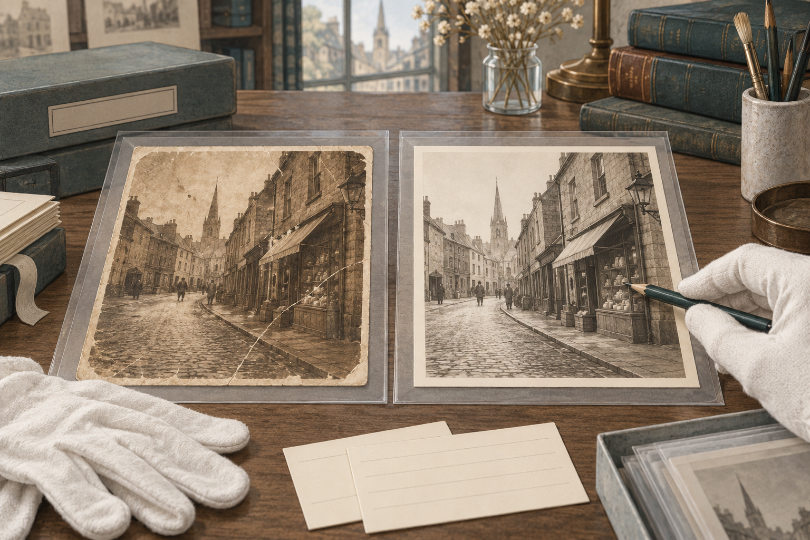
The caption is where an attractive derivative can acquire more authority than intended. A sentence about a particular sign or person should be supported by the source material and the research record. Read each claim while looking at the original, then check whether the derivative makes the claim seem more certain than the evidence allows.
| Caption element | Editorial question |
| Name on a sign | Is the spelling established outside the reconstructed pixels? |
| People present | Does cleanup remove someone relevant to the description? |
| Building detail | Was that edge visible in the source or supplied during the edit? |
| Date or location | What catalogue record or research supports the identification? |
This ledger is a proposed review method, not a report of a restoration experiment. Use it to identify claims that need a source note, a softer formulation, or a different image. The derivative can remain useful even when it is unsuitable for proving one particular detail.
A Display Note Should Describe the Actual Change
An AI Photo Editor may help an archive prepare a more legible display, but readers benefit from knowing which version they are seeing. A note that names a repaired scratch is more informative than a vague statement that the image was improved. With PicEditor AI or any similar tool, describe the intervention at the level that matters to the article’s claims.
A derivative used for illustration can be labelled accordingly while the source remains available to the editorial team. Avoid claiming that the process recovered missing historical information. If a detail has been reconstructed for visual continuity, that is precisely the distinction the working record should preserve.
Keep the display note with the export rather than in a separate general instructions folder. The practical risk is a lost relationship: a correct explanation is ineffective if nobody can tell which altered image it describes.
Resolve Disagreement Before the Image Enters Layout
If an editor sees damage and a researcher sees a potentially meaningful object, pause that alteration. Ask what additional material could settle the question: another scan, a related photograph, or the collection’s catalogue notes. A crop that leaves the disputed area visible may be preferable to a repair that decides the issue through appearance.
Layout staff should receive the approved version and its accompanying note together. Otherwise a carefully qualified image may arrive on the page without the explanation that made it acceptable. Check the proof to ensure the note remains attached when the image moves or its caption is shortened.
Accession the Pair With a Usable Trail
Return the final derivative to the archive with the source relationship and change record intact. A future editor should be able to answer what changed, why it changed, and which file preserves the original scan. That does not require an elaborate system; it requires an unambiguous one.
The successful cleanup is the one whose role remains clear after its maker has moved on. It can make a display easier to read while leaving the archive’s evidence available for new questions, including questions that today’s feature never thought to ask.